


Progression consequences
Clinical consequences of MAC lung disease progression
What happens if MAC lung disease is not treated?
Untreated MAC infection can induce chronic airway inflammation, which can lead to progressive airway damage and injury.1-3
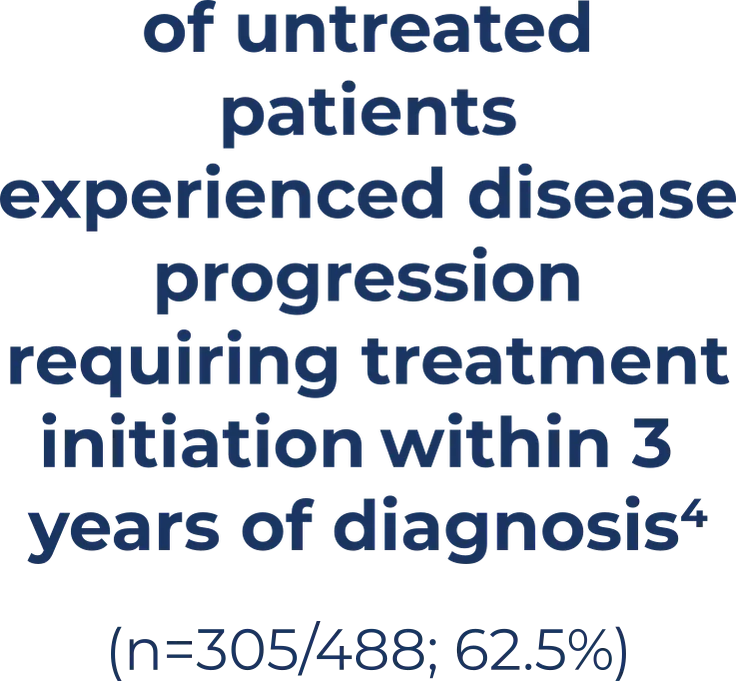
Persistent MAC lung infection can lead to disease progression within 3 years4
A retrospective study identified risk factors for MAC lung disease progression in 488 newly diagnosed patients. Within 3 years of diagnosis, untreated patients with comorbidities (including fibrocavitary disease, positive sputum AFB smear, or systemic symptoms) were at a significantly higher risk of clinical deterioration leading to treatment initiation than those without.4






MAC lung disease can have long-term effects
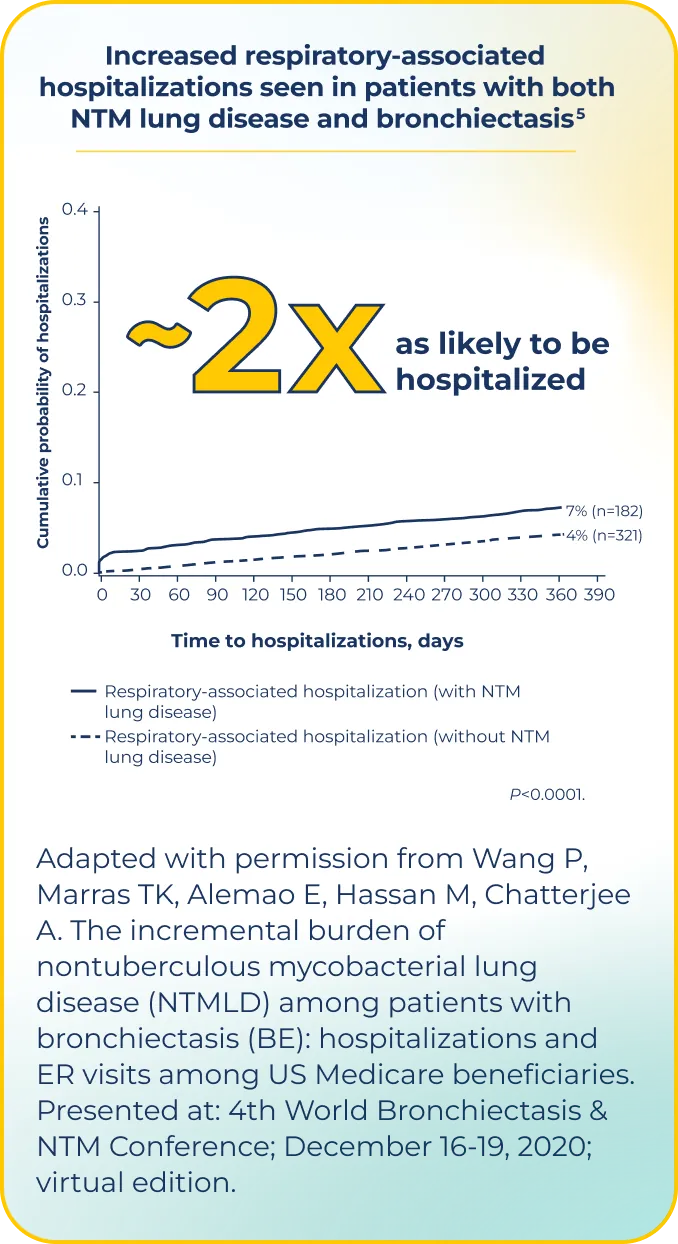
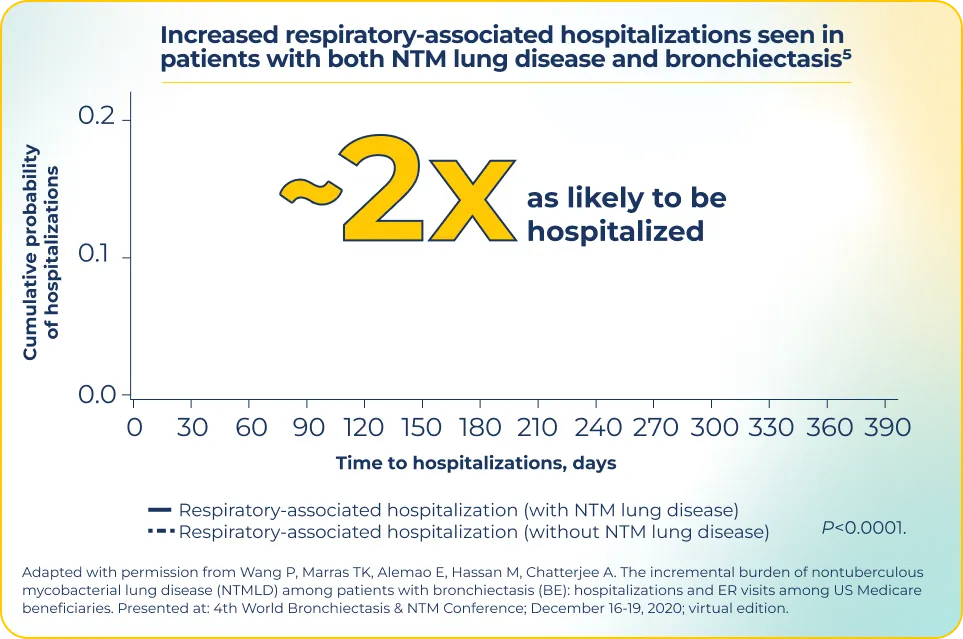
In a retrospective study, NTM lung disease increased the risk of respiratory-associated hospitalizations through 1 year in patients with comorbid lung conditions5
NTM lung disease can complicate preexisting comorbid lung conditions such as bronchiectasis or COPD. In a retrospective study of the HCRU of Medicare beneficiaries, patients with bronchiectasis and NTM lung disease (n=2512) had approximately twice the risk of respiratory-associated hospitalizations compared to those with bronchiectasis alone (n=7536).5




MAC lung disease progression can cause irreversible lung damage and can significantly worsen patient outcomes.6

Examine clinical studies of multidrug therapy in MAC lung disease and information about considerations for your patients
AFB=acid-fast bacilli; CI=confidence interval; ER=emergency room; FVC=forced vital capacity; HCRU=healthcare resource utilization; HR=hazard ratio; NTM=nontuberculous mycobacteria; NTMLD=NTM lung disease.
References: 1. Pathak K, Hart S, Lande L. Nontuberculous mycobacteria lung disease (NTM-LD): current recommendations on diagnosis, treatment, and patient management. Int J Gen Med. 2022;15:7619-7629. doi:10.2147/IJGM.S272690 2. Lee G, Kim HS, Lee KS, et al. Serial CT findings of nodular bronchiectatic Mycobacterium avium complex pulmonary disease with antibiotic treatment. AJR Am J Roentgenol. 2013;201(4):764-772. doi:10.2214/AJR.12.9897 3. Fujita J, Ohtsuki Y, Shigato E, et al. Pathological findings of bronchiectases caused by Mycobacterium avium intracellulare complex. Respir Med. 2003;97(8):933-938. doi:10.1016/s0954-6111(03)00120-3 4. Hwang JA, Kim S, Jo KW, Shim TS. Natural history of Mycobacterium avium complex lung disease in untreated patients with stable course. Eur Respir J. 2017;49(3):1600537. doi:10.1183/13993003.00537-2016 5. Wang P, Marras T, Alemao E, Hassan M, Chatterjee A. The incremental burden of nontuberculous mycobacterial lung disease (NTMLD) among patients with bronchiectasis (BE): hospitalizations and ER visits among US Medicare beneficiaries. Presented at: 4th World Bronchiectasis & NTM Conference; December 16-19, 2020; virtual edition. 6. Park TY, Chong S, Jung JW, et al. Natural course of the nodular bronchiectatic form of Mycobacterium avium complex lung disease: long-term radiologic change without treatment. PLoS One. 2017;12(10):e0185774. doi:10.1371/journal.pone.0185774